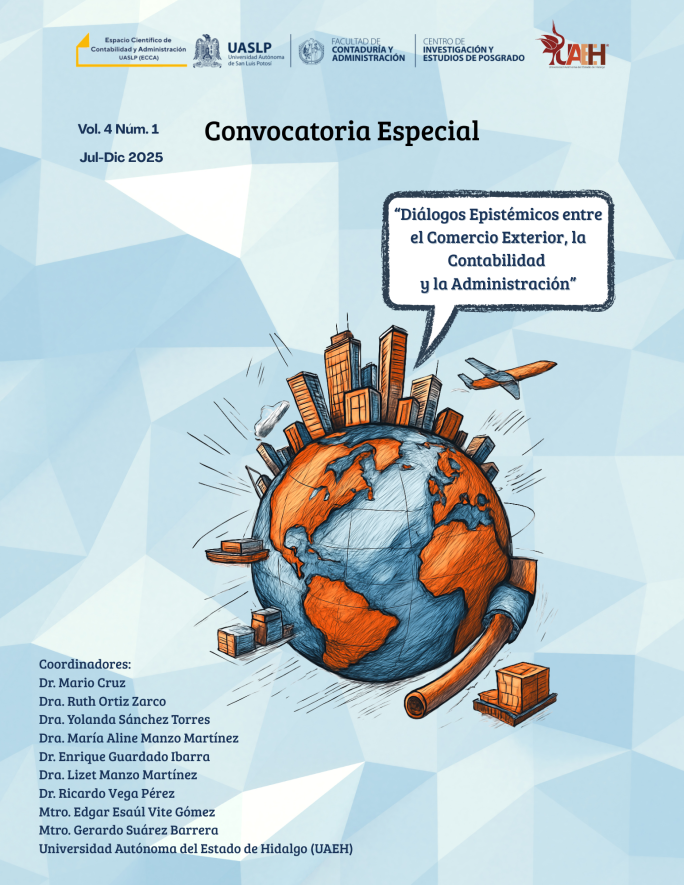
Perceived quality and continuity in postgraduate programs in education: a longitudinal study in Mexico.
DOI:
https://doi.org/10.58493/ecca.2025.4.1.23Keywords:
Perceived quality, Student retention, Graduate education, Curriculum design, Institutional permanence.Abstract
This article analyzes the relationship between perceived quality and program continuity in a graduate education program in San Luis Potosí, Mexico. Using a quantitative, non-experimental longitudinal design (2011–2015), a total of 1,758 questionnaires were applied to the entire student body. The instrument, structured on a five-point Likert scale, measured three dimensions: human resources, curriculum design, and service points, achieving excellent reliability (α = 0.967). Descriptive results indicated high levels of perceived quality; however, regression models revealed that the “service point” dimension negatively affects continuity, while the other dimensions were not significant. Findings suggest that quality, while necessary, is insufficient to explain permanence in graduate programs, highlighting the importance of institutional support, financial conditions, and academic integration. Managerial implications for postgraduate program administration are discussed, and future research directions are proposed.
References
Albayda, M. R. (2025). Service Quality of Private Higher Educational Institutions in Kabankalan City as a Determinant of Student Retention. Journal of Interdisciplinary Perspectives, 3(8), 331-344. DOI: https://doi.org/10.69569/jip.2025.447
Albornoz-Toyohama, R. H., Mendigure-Hachircana, R., Haro-Casildo, S., & Abanto-Ramírez, C. D. (2025, March). Factors influencing student retention university students: an analysis of institutional reputation, social responsibility and loyalty. In Frontiers in Education (Vol. 10, p. 1499518). Frontiers Media SA.
Argyris & Schön (1996). Organizational Learning. Madrid: Adisson Wesley.
Asociación Nacional de Universidades e Instituciones de Educación Superior. (2023). Anuario estadístico de educación superior: Técnico superior, licenciatura y posgrado 2022–2023. ANUIES. https://www.anuies.mx/gestor/data/personal/anuies05/anuario/Anuario_Educacion_Superior_2023-2024.zip
Bean, J. P. (1980). Dropouts and turnover: The synthesis and test of a causal model of student attrition. Research in higher education, 12(2), 155-187.
Barajas Villarruel, J., Pedraza Melo, N., & González Cisneros, A. (2024). Influencia del aprendizaje organizacional en el desempeño de organizaciones educativas tecnológicas de nivel medio superior. Revista Venezolana de Gerencia, 29(105), 343–365.
Clewes, D. (2003). A student-centred conceptual model of service quality in higher education. Quality in higher education, 9(1), 69-85.
Consejo Nacional de Humanidades, Ciencias y Tecnologías. (2024). Informe de gestión gubernamental 2018-2024. https://secihti.mx/wp-content/uploads/transicion/Informe_Consolidado.pdf?utm_source=chatgpt.com
EAB. (2025). 3 hidden retention challenges facing higher ed in 2025. Student Success Blog. https://eab.com/resources/blog/student-success-blog/3-hidden-retention-challenges-facing-higher-ed-in-2025/
George, D. & Mallery, P. (2003). SPSS for Windows step by step: A Simple Guide and Reference. 11.0 Update (4.ª ed.). Boston: Allyn & Bacon
Haabazoka, L., Banda, M., & Chanda, P. (2025). Customer satisfaction as mediator in the relationship between higher education service quality and loyalty. Journal of Service Research in Education, 18(1), 15–34.
Higher-Ed Marketing. (2025). Strategies to improve student retention. https://www.higher-education-marketing.com/blog/strategies-to-improve-student-retention
LGPDPPSO. (2025). Cámara de Diputados del H. Congreso de la Unión. https://www.diputados.gob.mx/LeyesBiblio/pdf/LGPDPPSO.pdf.
López, M., & Méndez, R. (2022). Calidad docente y satisfacción estudiantil en posgrados mexicanos. Revista de Educación Superior, 51(4), 25–47.
Manu, P. (2024). Graduate student retention in the United States: Challenges and solutions. International Journal of Higher Education Research, 13(3), 55–72.
NSC Research Center. (2025). Persistence & retention report 2025. https://nscresearchcenter.org/persistence-retention/
O’Neill, M., & Palmer, A. (2004). Importance-performance analysis: A useful tool for directing continuous quality improvement in higher education. Quality in Higher Education, 10(1), 19–36.
Parasuraman, A., Zeithaml, V., & Berry, L. (1988). SERVQUAL: A multiple-item scale for measuring consumer perceptions of service quality. Journal of Retailing, 64(1), 12–40.
Tinto, V. (1993). Rethinking the causes and cures of student attrition (2nd ed.). Chicago, IL: University of Chicago Press.
Tinto, V. (2017). Through the eyes of students. Journal of College Student Retention: Research, Theory & Practice, 19(3), 254–269.
Verostek, K., Sun, M., & Tan, R. (2023). Graduate student retention and research group integration: A qualitative study. Studies in Graduate Education, 8(2), 101–120.
Downloads
Published
How to Cite
Issue
Section
Categories
License
Copyright (c) 2026 Angélica Cárdenas Martínez

This work is licensed under a Creative Commons Attribution-NonCommercial-ShareAlike 4.0 International License.
Usted es libre de:
- Compartir — copiar y redistribuir el material en cualquier medio o formato
- Adaptar — remezclar, transformar y construir a partir del material
- La licenciante no puede revocar estas libertades en tanto usted siga los términos de la licencia
Bajo los siguientes términos:
- Atribución — Usted debe dar crédito de manera adecuada , brindar un enlace a la licencia, e indicar si se han realizado cambios . Puede hacerlo en cualquier forma razonable, pero no de forma tal que sugiera que usted o su uso tienen el apoyo de la licenciante.
- NoComercial — Usted no puede hacer uso del material con propósitos comerciales .
- CompartirIgual — Si remezcla, transforma o crea a partir del material, debe distribuir su contribución bajo la la misma licencia del original.
- No hay restricciones adicionales — No puede aplicar términos legales ni medidas tecnológicas que restrinjan legalmente a otras a hacer cualquier uso permitido por la licencia.