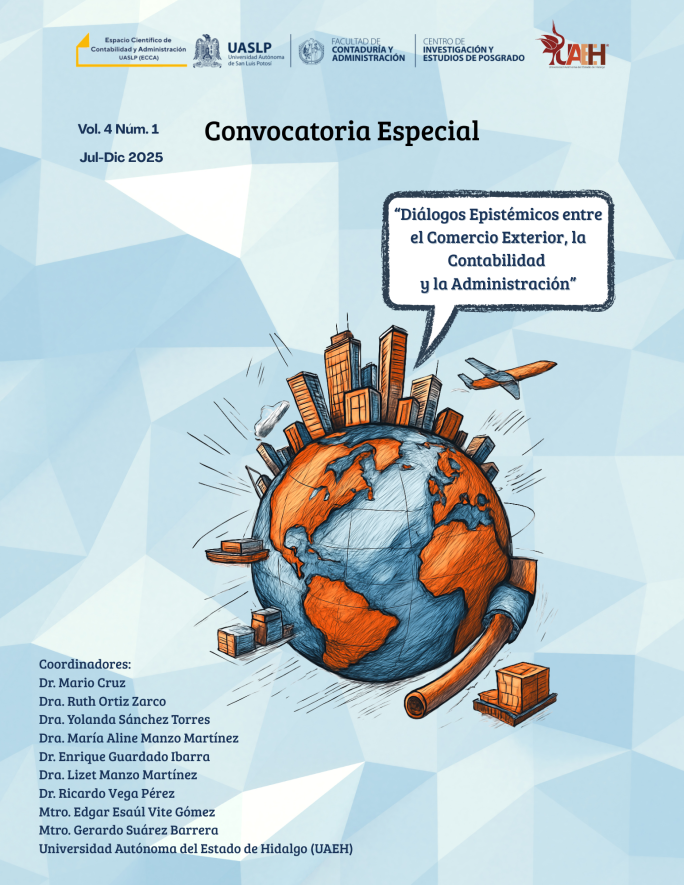
Towards a conscious digitalization: technological sovereignty and sustainability as new axes of competitiveness for SMEs.
DOI:
https://doi.org/10.58493/ecca.2025.4.1.08Keywords:
Technology, commerce, business, successAbstract
Technology has become an essential part of daily life and the internet is a key tool for accessing information and opportunities. These developments have transformed trade, generating new markets and jobs, but they also require spaces where technology can be shared and used effectively. Digital competence is fundamental today: it is not enough to use devices, but to do so with responsibility, creativity and critical thinking, The pandemic has accelerated the growth of digital markets and businesses, forcing companies to adapt in order to continue operating. This change spurred the creation and strengthening of online enterprises and large businesses. Between 2020 and 2023, digital transformation enabled many organizations to increase their profits and change the way society conducts its business. Currently, technology represents a great advantage for businesses, especially with e-commerce. It used to be difficult to make yourself known, but now you can grow faster if you follow the right path. Start-ups face challenges such as lack of resources and competition with established brands, but digital marketing allows them to stand out and reach their audience. This type of marketing has become a key tool for a new business to succeed.
References
Andreazzi, F. (2024). Leadster. Obtenido de Leadster: https://getleadster.com/blog/marketing-theories/
Forradellas, R. (2024). Impacto de la digitalización en los nuevos modelos de negocio. Dykinson.
González, J. D. (2023). Teconológico de Antioquia Institución Universitaria. Obtenido de Teconológico de Antioquia Institución Universitaria: https://dspace.tdea.edu.co/server/api/core/bitstreams/34cd46a6-7da7-43d0-a2cb-54383f8d4c20/content
Guevara, E. E. (2023). LA DIGITALIZACIÓN COMO UNA HERRAMIENTA DE CRECIMIENTO PARA LAS PyMES MEXICANAS DEL SECTOR MINORISTA EN MERCADOS INTERNACIONALES. CEDS, 30.
Kotler, P. (2024). Marketing 5.0. Madrid, España: LID.
Machado, E. G. (2021). Revista Alcance. Obtenido de Revista Alcance: http://scielo.sld.cu/scielo.php?pid=S2411-99702021000200037&script=sci_arttext&tlng=pt
Mayorga, V. P. (2022). Repositorio UAEH. Obtenido de Repositorio UAEH: https://repository.uaeh.edu.mx/revistas/index.php/sahagun/article/view/8738/9089
Murillo, M. d. (2025). Grupo Editorial ALEMA. Obtenido de Grupo Editorial ALEMA: https://editorialalema.org/index.php/pentaciencias/article/view/1410/1893
Negro, M. (2024). Mercado Negro. Obtenido de Mercado Negro: https://www.mercadonegro.pe/marketing/marketing-digital/el-marketing-digital-segun-philip-kotler/
Núñez, S. F. (2024). IROCAMM. Obtenido de IROCAMM: https://revistascientificas.us.es/index.php/IROCAMM/article/view/24809/23076
Octavio Rolando Lara Martínez, G. A. (2024). Impacto del comercio electrónico en las pequeñas empresas de México. LATAM, 14.
Phoenix, U. d. (2024). University of Phoenix. Obtenido de University of Phoenix: https://www.phoenix.edu/professional-development/blog/inbound-vs-outbound-marketing/
Rubín, C. N. (2024). Dialnet. Obtenido de Dialnet: https://dialnet.unirioja.es/servlet/articulo?codigo=9693743
Downloads
Published
How to Cite
Issue
Section
Categories
License
Copyright (c) 2026 Oscar Apolo García Avila, Edgar Esaúl Vite-Gómez, Lizet Manzo Martinez

This work is licensed under a Creative Commons Attribution-NonCommercial-ShareAlike 4.0 International License.
Usted es libre de:
- Compartir — copiar y redistribuir el material en cualquier medio o formato
- Adaptar — remezclar, transformar y construir a partir del material
- La licenciante no puede revocar estas libertades en tanto usted siga los términos de la licencia
Bajo los siguientes términos:
- Atribución — Usted debe dar crédito de manera adecuada , brindar un enlace a la licencia, e indicar si se han realizado cambios . Puede hacerlo en cualquier forma razonable, pero no de forma tal que sugiera que usted o su uso tienen el apoyo de la licenciante.
- NoComercial — Usted no puede hacer uso del material con propósitos comerciales .
- CompartirIgual — Si remezcla, transforma o crea a partir del material, debe distribuir su contribución bajo la la misma licencia del original.
- No hay restricciones adicionales — No puede aplicar términos legales ni medidas tecnológicas que restrinjan legalmente a otras a hacer cualquier uso permitido por la licencia.